Pellet Feed vs Mash Feed: Which Feed Type Is More Profitable?
Pellet Feed vs Mash Feed
Cost, Efficiency and Profitability Comparison for Feed Producers
When starting or upgrading an animal feed business, one of the most important decisions is:
Should you produce pellet feed or mash feed?
Both feed types are widely used in the livestock industry, but they differ significantly in:
• Production cost
• Equipment investment
• Feed efficiency
• Market price
• Profitability
This article provides a detailed comparison between pellet feed and mash feed, helping investors choose the most profitable option.
1. What is Mash Feed?
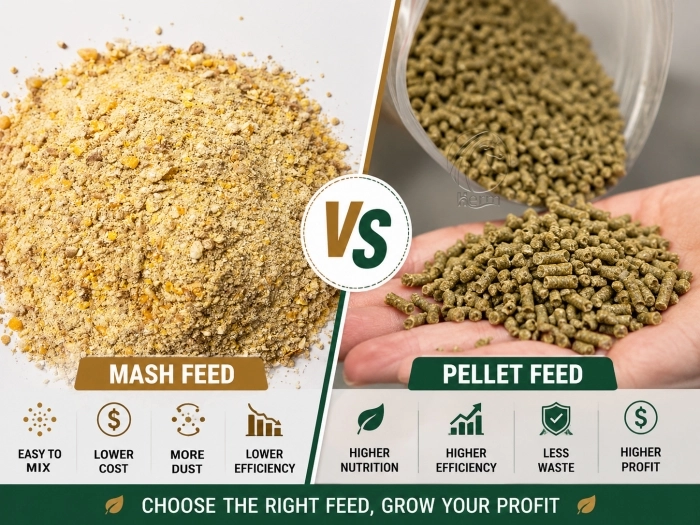
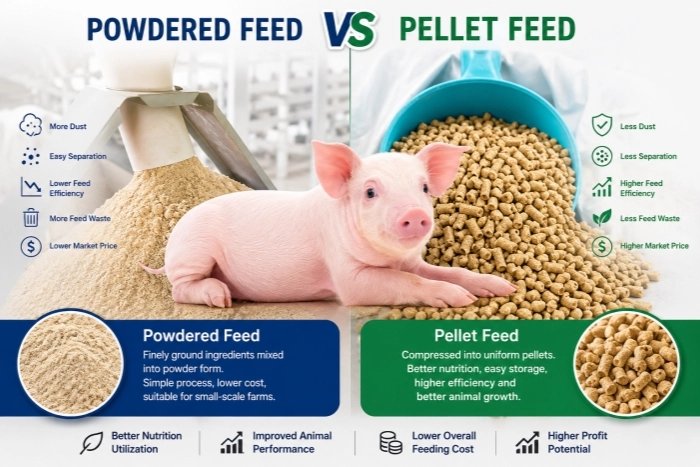
Mash feed is a powdered or loose mixture made from ground raw materials.
Main Characteristics
• Simple production
• Low equipment investment
• Commonly used in small farms
Advantages of Mash Feed
✅ Lower investment cost
✅ Simple production process
✅ Lower energy consumption
✅ Suitable for small-scale production
Disadvantages of Mash Feed
❌ Dust generation
❌ Feed separation during transportation
❌ Lower feed conversion ratio (FCR)
❌ Higher feed waste
2. What is Pellet Feed?
Pellet feed is produced by compressing mixed feed into uniform pellets using a pellet mill.
Main Characteristics
• Compact structure
• Better digestibility
• Improved feed efficiency
Advantages of Pellet Feed
✅ Higher feed conversion efficiency
✅ Reduced feed waste
✅ Better animal growth performance
✅ Easier storage and transportation
✅ Higher market acceptance
Disadvantages of Pellet Feed
❌ Higher equipment investment
❌ Higher energy consumption
❌ More complex production process
3. Production Cost Comparison
Which Feed Type is Cheaper to Produce?
| Cost Item | Mash Feed | Pellet Feed |
| Equipment Cost | Low | High |
| Energy Consumption | Low | Higher (+10%–20%) |
| Labor | Low | Medium |
| Maintenance | Low | Medium |
Pellet feed costs more to produce because it requires pelleting and cooling processes.
4. Selling Price Comparison
Which Feed Type Has a Higher Selling Price?
| Feed Type | Price Range |
| Mash Feed | $250 – $400 / ton |
| Pellet Feed | $350 – $600 / ton |
Pellet feed usually sells at a 10%–25% higher price.
5. Profit Margin Comparison
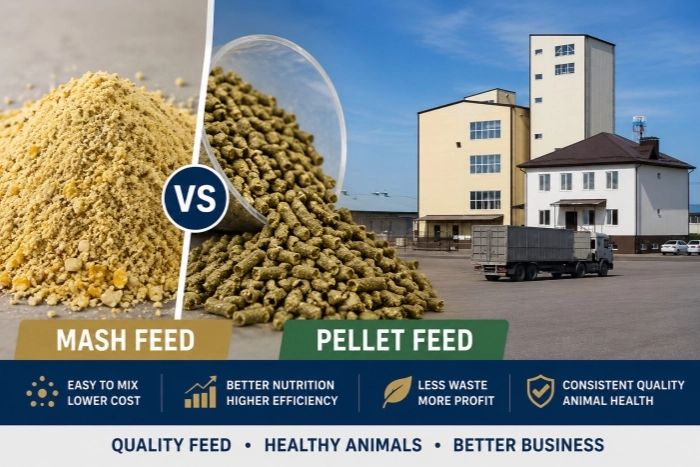
Which Feed Type is More Profitable?
Mash Feed
• Profit margin: 5% – 10%
• Lower selling price
• Improved feed efficiency
Pellet Feed
• Profit margin: 10% – 25%
• Higher selling price
• Better feed efficiency
Example Profit Calculation
Mash Feed
• Production cost: $300/ton
• Selling price: $330/ton
• Profit: $30/ton
• Margin: ~9%
Pellet Feed
• Production cost: $350/ton
• Selling price: $420/ton
• Profit: $30/ton
• Margin: ~16%–20%
6. Feed Conversion Efficiency
Why Does Pellet Feed Generate More Profit?
Pellet feed improves:
• Digestibility
• Nutrient absorption
• Animal growth performance
Feed Conversion Ratio (FCR)
| Feed Type | Efficiency |
| Mash Feed | Lower |
| Pellet Feed | Higher |
This means:
Farmers prefer pellet feed because it improves production performance and reduces feed waste.
7. Market Demand Comparison
Which Feed Type is More Popular?
Mash Feed
• Common in small farms
• Popular in low-cost markets
Pellet Feed
• Widely used in poultry farms
• Preferred by commercial feed operations
• Growing demand worldwide
In many markets, such as Algeria, pellet feed demand is increasing rapidly.
8. Investment vs Return
Which Option is Better for Investors?
Mash Feed Plant
• Lower investment
• Lower risk
• Limited profitability
Pellet Feed Plant
• Higher investment
• Moderate risk
• Higher profit margins
• Faster ROI
9. When Should You Choose Each Feed Type?
Choose Mash Feed If:
• You have a limited budget
• You target small farms
• You want a simple production system
Choose Pellet Feed If:
• You target commercial farms
• You want higher profitability
• You plan long-term business development
• You want stronger market competitiveness
10. Industry Trend
What is the Future Direction?
Global feed industry trends include:
✔ Transition from mash feed to pellet feed
✔ Increasing demand for high-quality feed
✔ Automation and large-scale production
Pellet feed production is becoming the future direction of the feed industry.
Conclusion
Both mash feed and pellet feed have their own market applications.
Mash Feed
✔ Lower investment
✔ Simple operation
✔ Suitable for small-scale production
Pellet Feed
✔ Higher selling price
✔ Better feed efficiency
✔ Stronger market demand
✔ Higher profit margins
For long-term profitability, pellet feed production is generally the better investment choice.
Contact us today to get your customized feed mill solution.
Henan Herm Machinery Co., Ltd was established in 2010 and has been devoted to the research and development of Feed MillMachinery ever since. With more than 10 years of experience, Herm® has become a leading manufacturer and supplier of animal feed machines and complete animal feed production lines, cattle feed plants, poultry feed plants, animal feed pellet production lines, etc. It has consistently endeavored to improve product quality and aims to meet the new requirements of the international market.
If You Are Ready to start a Feed Pellet Plant Business, please get in touch with us for the feed mill machine. We Can Provide Professional Design and Comprehensive Guidance According to Your Needs. Get in touch with us now!
Welcome, Contact Us!
Henan Herm Machinery Co., Ltd
Email: info@hermmachinery.com
Phone/Whatsapp: 0086-18037508651